A child and a dog both need an exit
Arrange the room, the adult’s attention and the end of the interaction before asking anyone to be gentle.
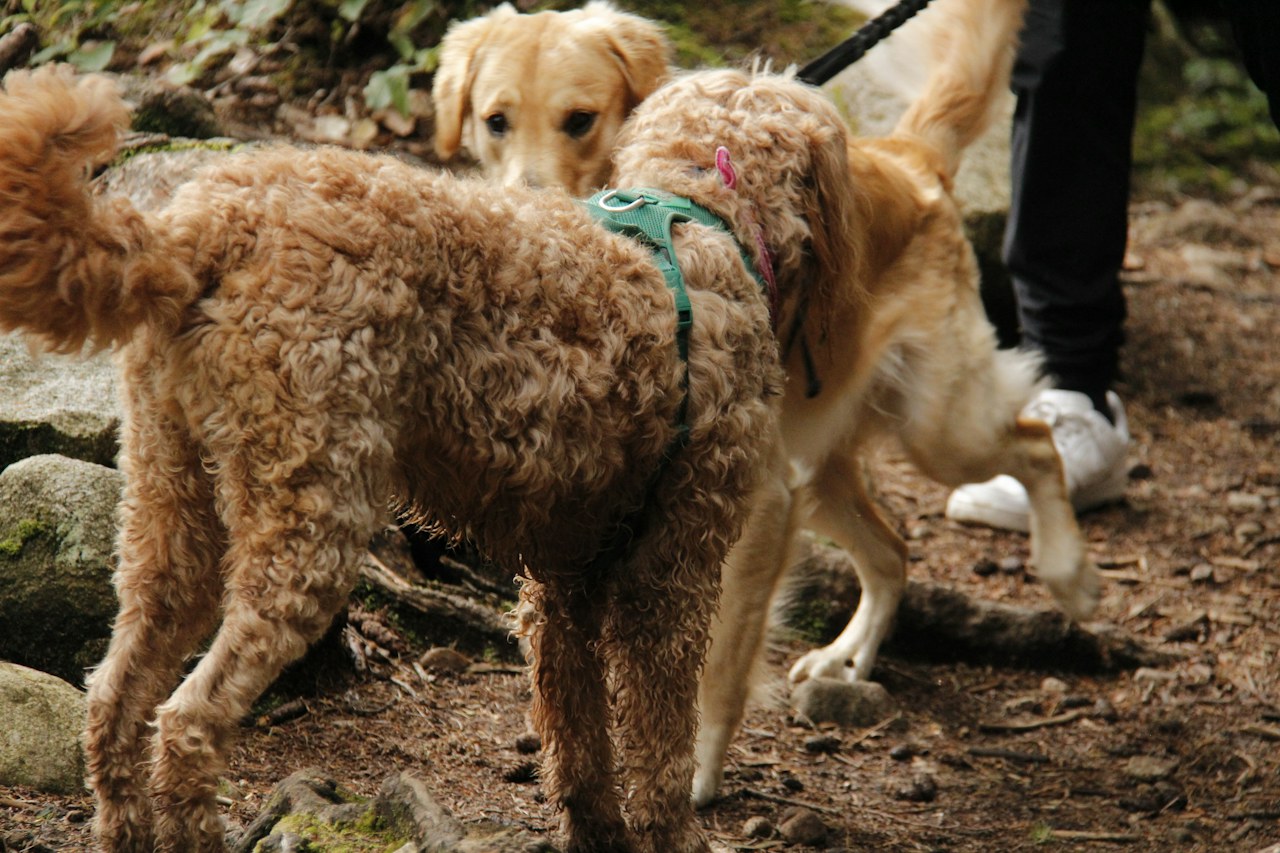
A photograph of two dogs together can make an introduction look like a single friendly moment. I am more interested in what happens around that moment: how the dogs arrive, whether either can create distance and what the people will do if the meeting needs to end. I would not make nose-to-nose contact the achievement that turns an outing into a success.
Imagine a hypothetical first meeting between two adult dogs, Fern and Moss, whose people are considering a shared household. Rae will handle Fern and Kit will handle Moss. In this invented example both dogs can take ordinary lead walks with their own person; it does not include a known unresolved aggression problem. The walk is a way to explain planning choices, not a claim that I trained these dogs or that a general article can assess whether two real animals should live together.
My first question would be what the people are trying to arrange. An accidental encounter on a narrow pavement is different from a planned meeting before a potential adoption. The latter allows questions to be asked in advance: what is known about each dog's behavior around other dogs, what support is available, and what setting fits both animals? I would use that opportunity rather than treat every unknown as something a quick sniff will resolve.
Dogs Trust recommends obtaining qualified behavior or training advice early when considering another dog, and emphasizes that individual dogs have different preferences. That is a useful limit on this article. If there is a history of serious conflict, fear, injury or uncertainty about managing either dog, the next step is individualized help from the appropriate professional or rehoming organization, not attempting the following imagined walk as a compatibility test.
Rae and Kit would therefore agree the purpose in ordinary language: give the dogs an appropriately managed opportunity to be aware of one another, without promising contact or a move home that day. They also would clarify any health concerns with the relevant veterinary or rehoming professionals. Calling the example adult-dog planning is deliberate. Puppy health, vaccination and developmental questions need their own guidance rather than a borrowed rule from this scenario.
The Dogs Trust introduction guidance gives each dog its own person and begins with lead walking at a comfortable separation. I would arrange the human help before setting the appointment. One person trying to manage both unfamiliar dogs loses much of the flexibility the example depends on. If a suitable second handler cannot come, postponing or asking the supporting organization for help is a practical choice, not a failed introduction.
For the hypothetical pair, I would look for a suitable open area outside the home with enough room to alter the route. A crowded dog exercise area or a narrow gate could remove the choices the people thought they had. Neutral ground is not simply a label applied to any park. The actual space needs to fit the dogs, the handlers, local access rules and the ability to keep an appropriate distance from others using it.
Before bringing the dogs close to the same starting area, Rae and Kit can agree where each will arrive and how either will leave. I would keep that conversation simple: which direction each person can walk, what signal means more space, and how they will avoid meeting again at the narrow exit. Appropriate walking equipment should already fit each dog. This first meeting is not the occasion to improvise an unfamiliar piece of equipment under pressure.
In the example, the people begin far enough apart that neither dog needs to deal with the other at close range. I would not set a universal number of metres or a required number of minutes. The useful observation is how each dog responds in the actual surroundings. If the available route cannot provide enough separation, a different setting or a postponed appointment may be more appropriate than trying to complete the plan in unsuitable space.
Rae and Kit also need permission to stop talking to one another and attend to their own dogs. A human conversation can keep two people stationary while their dogs have no useful way to change the encounter. Walking in the same general direction can give the handlers more options, provided the actual route and dogs allow it. I would let the supporting professional's advice and the animals' responses guide how that looks for this pair.
A small original planning note could say: Fern with Rae on one side of the open area; Moss with Kit at a suitable separation; either person can ask to move away. It would not say that the dogs must be side by side before the end. The note organizes people, not a training result. It makes the exit an available choice from the beginning instead of an emergency exception someone is embarrassed to request.
I would watch each dog rather than ask whether the more enthusiastic one is ready. One animal's approach does not provide the other's permission. In the hypothetical walk, suppose Fern is interested while Moss turns away when the people begin moving closer. I would preserve or increase the distance rather than interpret Fern's interest as a reason to complete the approach. The example is about responding to information, not labeling either dog good or difficult.
Dogs Trust describes possible discomfort signals and advises giving space when a dog is uncomfortable. A single movement still needs its context; an owner should not diagnose an entire emotional state from one isolated gesture. My practical response to uncertainty would be to reduce the pressure and obtain help interpreting the situation where needed. Asking a worried dog to remain in the same difficult position while people debate what the signal means would not improve the arrangement.
If the encounter includes substantial distress or behavior such as lunging or snapping, the plan should end with the dogs safely separated and qualified advice before another attempt. Dogs Trust recommends immediate veterinary attention for injury. I would not offer a do-it-yourself conflict-handling technique or instruct people to reach between dogs. The point of planning space and separate handlers is to retain choices before an interaction becomes something the people cannot safely manage.
The Dogs Trust sequence allows an on-lead greeting when both dogs are relaxed, followed by moving on; it also stresses working at their pace. I would keep that conditional language. Fern and Moss do not owe the people a greeting because the appointment has been booked. If the walk remains comfortable only with space between them, ending there may provide useful information without turning the closing minutes into a forced test.
Suppose both handlers, following suitable advice, decide a closer interaction is appropriate. I would still want the route to continue and both people to remain attentive, rather than gather around for a photograph. A friendly-looking instant does not establish how either dog will respond to a prolonged encounter. I would not use a camera-ready position, tangled leads or human excitement as reasons to keep the dogs together longer than the situation supports.
The cover photograph is an illustration of dogs outdoors, not a demonstration of this first-meeting arrangement or a record of Fern and Moss. Their names and circumstances are invented. That distinction matters because a picture cannot tell the reader the dogs' history, their relationship or what happened immediately outside the frame. I would not copy an unknown encounter's spacing or handling solely because it makes an appealing image.
Battersea explicitly distinguishes meeting on neutral ground from sharing a home. I would carry that distinction into Rae and Kit's conversation after the walk. An uneventful outing does not answer where each dog will rest, eat or spend time apart. Those questions deserve planning before a move, with the rehoming organization or qualified professional involved where appropriate. The walk is one part of an assessment and transition, not a certificate of future harmony.
In the hypothetical household, I would ask the people to describe two usable resting areas and a workable way to keep the dogs apart when needed. Battersea discusses separate feeding arrangements, attention to valued objects and individual space. The practical choices must suit the actual animals and home. A gate or other barrier should not be assumed secure for every dog simply because it worked in a different household or appeared in a photograph.
I also would keep the journey and the first arrival from becoming an unplanned extension of the greeting. How will the dogs travel appropriately, who is managing each one, and where does each go on arrival? The full answer depends on the situation and relevant advice. I would settle it before committing to the move rather than let the pleasant feeling after a walk make a shared car or a narrow doorway seem automatically straightforward.
Afterward, I would record a few useful observations: the setting, what separation was manageable, what changed when the distance changed and what the handlers did next. Statements such as moved away when we approached are more useful than unfriendly. The first describes something another professional can discuss; the second packages a complicated situation into a judgment that may travel well beyond the evidence supporting it.
I would note the limits too. A quiet open space differs from a home containing food, resting places and familiar people. A short meeting differs from a whole day together. If advice is needed, those contextual details help explain the actual question. They also prevent a reassuring note from being reused later as proof that every situation has already been assessed. Continued supervision and appropriate separation remain practical responsibilities, not details erased by one successful-looking moment.
The next decision might be another supported meeting, a change in the plan or recognition that this arrangement is not appropriate. I would not promise that sufficient patience makes every pair compatible. The kindness in a well-planned introduction includes room to change the human plan. It gives both dogs a better chance to communicate without making either animal responsible for fulfilling the picture the people had in mind.
I would plan a first meeting around choices rather than a picture: a capable person for each dog, space to move and permission to stop. The useful outcome is a clearer understanding of the next appropriate step, not proof that Fern and Moss have become friends on schedule. When the people can change the plan without blame, the dogs have more room to show what the situation is actually asking of them.
A: No. The guidance makes closer interaction conditional on both dogs being comfortable. A meeting can end without contact, and the people may need individual advice or a different plan. Do not use the end of an appointment as a reason to force the last step.
A: The Dogs Trust first-introduction guidance gives each dog its own handler. This example relies on that arrangement so each person can attend to one dog and create space. If appropriate help is unavailable, postpone or ask the supporting organization for assistance rather than improvise the same exercise alone.
A: No. Battersea distinguishes a neutral meeting from living together. Resting space, food, valued objects, supervision, separation and the transition home are additional considerations. Discuss the actual situation with the rehoming organization or an appropriately qualified professional instead of treating one walk as a complete assessment.
A: End the encounter with the dogs safely separated rather than persisting. Dogs Trust advises qualified training or behavior support before another introduction after significant discomfort, and immediate veterinary advice for injury. This article does not give an emergency physical-intervention technique or replace individualized professional assessment.
A: This worked example is deliberately about adult dogs already able to take ordinary lead walks. Puppies raise additional health, vaccination and developmental questions. Ask your veterinarian and the responsible rehoming organization or breeder for guidance suitable to the actual puppy and resident dog; do not infer a vaccination timetable from this article.
Reference details checked Nov 24, 2026. Rules and guidance can change; follow the current source where applicable.
Something needs a correction? Let us know.
Arrange the room, the adult’s attention and the end of the interaction before asking anyone to be gentle.
Move bags out of the bottleneck, give the dog space, and rehearse one manageable arrival before guests come over.
Choose a quieter loop, leave room for safe pauses, and stop every interesting hedge becoming a race to get home.