A harness fit check before the walk
Compare actual measurements, watch the straps during a turn, and check the fit before heading through the door.
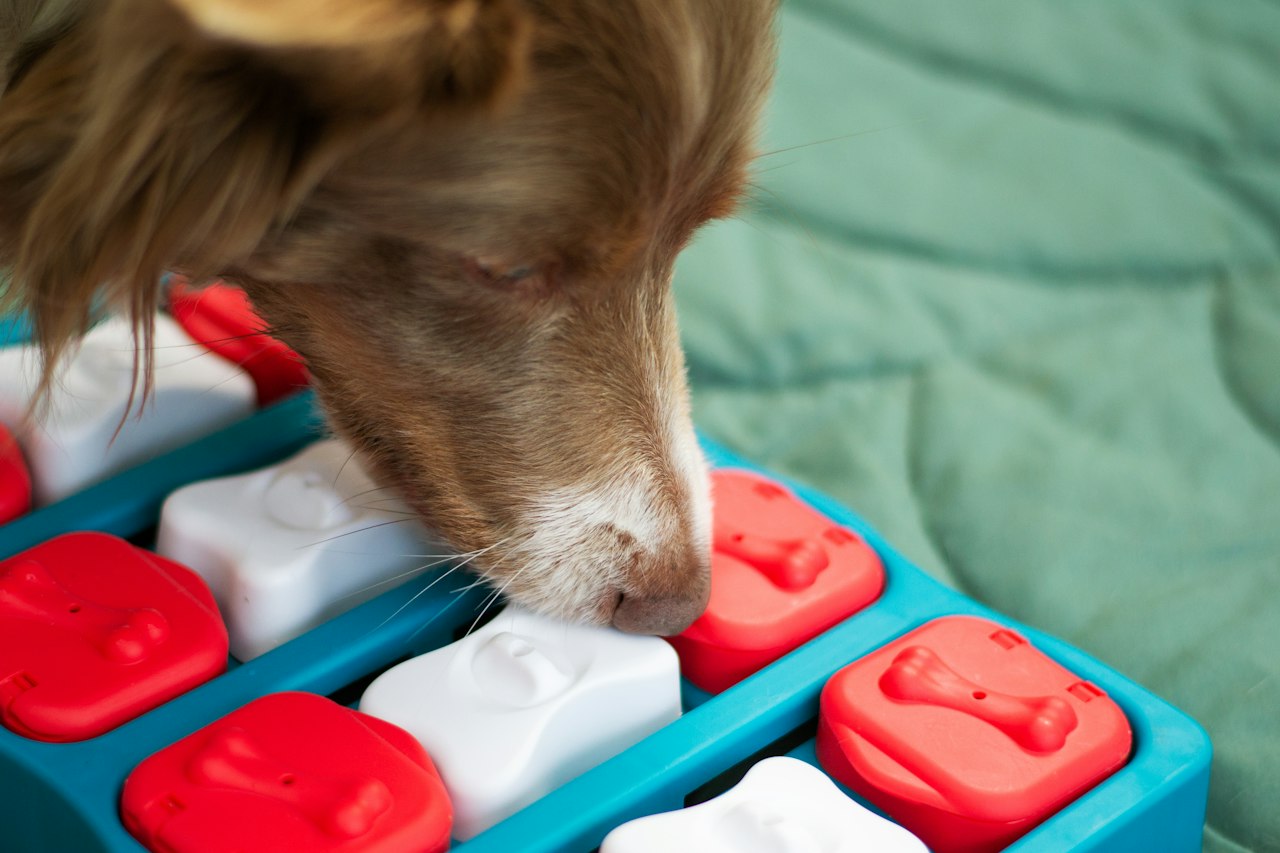
Here is the first attempt I want to unpack: a household puts food into every compartment of a new puzzle, closes the sliding covers and sets it on the floor. The dog noses an edge, paws at the whole object and sends it skittering. I can see why someone might reach for the instructions to discover the trick. My first question is simpler: did we give the dog an understandable starting point?
I would begin with one easy opportunity, a suitable surface and supervision close enough to intervene safely. Dogs Trust and Battersea describe food-based enrichment as interesting activity, with suitable food included in the daily plan. The difficulty rating is not the achievement here. I want to follow the dog’s approach, the action that makes food accessible, and the moment when the object should go away.
Before returning the puzzle to the floor, I would decide what this particular session is for: a short, supervised opportunity to investigate part of an ordinary meal. That keeps the goal small enough to evaluate. I am not asking the toy to solve distress during absences, replace suitable exercise or prove the dog is clever. In a shared household, I would say that aloud so the next person does not leave the same object during a difficult departure and expect the same experience. The setting is part of the choice.
Consider the dog’s ordinary behavior with objects. Does the animal gently investigate, carry things away or chew materials apart? A product that works for one style may be unsuitable for another. Ask the veterinary team about any health, dental or dietary restrictions that affect the choice. The purchase should fit the animal and the routine, rather than require the dog to become a different kind of user.
Look at how food becomes available and which parts the dog will contact. Check the manufacturer’s size guidance, intended use, cleaning instructions and warnings. Avoid items with damaged pieces, uncertain attachments or openings that seem inappropriate for the individual dog. A puzzle that slides across the floor may add difficulty unrelated to the intended task, so choose a suitable stable surface and keep the surrounding area clear.
Do not assume a higher price or a durable label makes supervision unnecessary. Battersea recommends watching dogs with puzzle toys and activity feeders to prevent harmful chewing or swallowing. The person needs to be able to notice when the toy stops functioning as intended. If the dog’s main activity becomes dismantling the object or trying to consume parts, end the session safely and reconsider the design rather than praising persistence.
Begin with a simple version in which suitable food is visible or readily accessible. If the product allows covers to remain open, use that option rather than setting every mechanism to its hardest position. Let the dog investigate without holding its paw or nose against a moving part. The useful lesson is that an ordinary action can lead to food, not that the person must physically demonstrate the answer on the animal’s body.
Keep the amount modest and within the feeding plan. A short first attempt gives you room to observe and adjust. If the dog walks away, consider the food, location and level of difficulty before assuming disinterest in enrichment generally. If the dog becomes increasingly forceful, simplify or stop. There is no value in making necessary nutrition inaccessible to prove the animal will eventually solve the problem.
A simple open searching surface, a food-dispensing object and a sliding-compartment puzzle ask for different movements. The first may allow easy sniffing and collection, the second may move around the room, and the third may require the dog to discover a particular manipulation. None is automatically best. Compare the physical task with the dog’s size, mobility, previous experience and tendency to chew or carry objects.
For a household example, suppose the dog investigates gently but becomes unsure when a hard object rolls across a noisy floor. A stable, easy-access option may be a more useful first choice than a rolling dispenser. Another dog may enjoy movement but immediately chew a soft searching mat. The comparison is about observed use, not a ranking of clever and less clever animals. Choose the design that creates a safe, understandable activity in the actual room.
| Style | Useful question | Possible mismatch |
|---|---|---|
| Easy searching surface | Can the dog collect food comfortably? | Material is chewed or swallowed |
| Moving dispenser | Is movement manageable in this room? | Noise, sliding or collisions |
| Sliding compartments | Can the mechanism begin mostly open? | Too many unfamiliar actions at once |
If the dog can reach the food comfortably in the easy arrangement, my next change would be almost unremarkable. Where the product supports it, I might partly cover one compartment and keep the others accessible. Same location, same familiar food, just one different action to understand. I would watch that action rather than count how long the puzzle lasts. Frustration, abandonment or unsafe use is a reason to simplify or stop, not to close more covers. Keeping the easy version is a perfectly useful decision if that is what works comfortably.
A useful record describes the action: found visible pieces, moved one cover, then began biting the edge. That suggests where the setup changed from manageable investigation to something less useful. The next session can simplify that point or use another suitable design. Do not keep increasing difficulty solely because the dog finishes quickly. The goal is an enjoyable experience, not extending the time until food becomes available as far as possible.
Food placed in a puzzle still belongs in the daily feeding plan. Measure the intended portion before filling the toy and let other caregivers know what has been allocated. If the product uses treats rather than the main food, retain the label information and count the amount appropriately. A training session, a chew and a puzzle can all look small in isolation while adding up across the day.
Do not reduce a prescribed diet or substitute an unsuitable ingredient because an online filling recipe looks convenient. Ask the veterinary team how enrichment can fit a therapeutic or restricted feeding plan. The puzzle is a delivery method, not permission to change the diet. Keep a normal suitable feeding option available while the dog is learning, so a difficult toy does not become an obstacle to adequate nutrition.
Food activities can change the atmosphere in a multi-pet room. One dog may hover beside another’s puzzle or take over as soon as food appears. Provide suitable separation and supervision rather than expecting the animals to share one object politely. A quiet dog who leaves may be avoiding competition, not demonstrating that the toy is boring. The arrangement should let each animal use an appropriate activity without being crowded.
Do not ask children to retrieve a puzzle from a dog or take food away to test tolerance. Adults should manage the setup and end it safely. If guarding, growling or other conflict appears, stop the shared arrangement and seek veterinary or qualified behavior advice. The next step is an individual safety plan, not a more complicated puzzle intended to keep everyone too busy to notice one another.
Check whether food can be removed from every compartment and whether the item can be cleaned and dried as directed. A design that traps residue in places the household cannot reach may be impractical, especially with moist food. Follow the manufacturer’s instructions and appropriate food hygiene. The toy should be ready for the next use, not stored with yesterday’s leftovers because disassembly is frustrating.
Inspect the item as you clean it. Cracks, loose pieces, worn material or unreliable fastenings can change the safety of a previously useful product. Keep the instructions and replace damaged items appropriately. If the puzzle requires more maintenance than the household can reliably provide, choose a simpler option. Ease of cleaning is not a secondary luxury; it determines whether the activity can remain part of an ordinary routine.
The finish matters as much as the first nose toward the toy. If the dog reaches the food comfortably and moves away, I would let that be enough, even if the session is short. The empty puzzle can be cleaned and stored as appropriate instead of remaining available to become a chew. At the next supervised opportunity, I would notice whether the dog approaches voluntarily and whether the familiar easy action still makes sense. Those observations tell me more about this activity than stretching it to fill a predetermined number of minutes.
Keep variety available through suitable play, exploration, rest and social interaction as well as food activities. A puzzle is one useful option among many. If the dog’s appetite, interest or physical ability changes, discuss that with the veterinary team rather than assuming the product needs a harder setting. The best choice is one that fits the dog today and can be adjusted or retired when that fit changes.
I would put away the puzzle without worrying that an easy version wasted its clever design. The useful change was making the first action understandable, then noticing what the dog did with that opportunity. A stable setup, accessible food, supervision and a sensible finish turn the object into an activity; extra difficulty only earns a place when it helps.
A: No. Begin with an understandable, easy version and observe how the dog uses it. Difficulty is only useful when the animal can engage comfortably. A puzzle that produces frustration, unsafe chewing or avoidance needs simplifying or replacing, not a longer compulsory session.
A: Yes. Allocate suitable food within the agreed feeding plan and tell other caregivers what has been used. Treat fillings, chews and training rewards can add up. Ask the veterinary team how to fit enrichment into a restricted or therapeutic diet.
A: Do not make an unattended absence the first trial. Introduce and supervise suitable toys, follow their instructions and assess how the individual dog uses them. A food puzzle is not a treatment for separation-related distress and may be ignored or damaged in a difficult context.
A: Consider whether that action is safe and consistent with the product’s intended use. If it creates loose parts, harmful chewing or an unstable situation, stop. A different stable design or easier setup may be more suitable than trying to force the dog to use the mechanism exactly as a person expects.
A: No. A short enjoyable activity can still be useful. Look at comfortable engagement and safe use rather than maximizing duration. You can vary appropriate activities across the day without turning every meal into a difficult test or buying the next level immediately.
Reference details checked Nov 10, 2026. Rules and guidance can change; follow the current source where applicable.
Something needs a correction? Let us know.
Compare actual measurements, watch the straps during a turn, and check the fit before heading through the door.
Choose for security and everyday comfort, then practice entry, closure and lifting as separate steps.
Check access, freshness and placement first, then decide whether a fountain solves a problem your cat actually has.