A litter tray location audit, from the cat’s height
Compare routes, noise and everyday access to find the barriers a tidy-looking litter corner can hide.
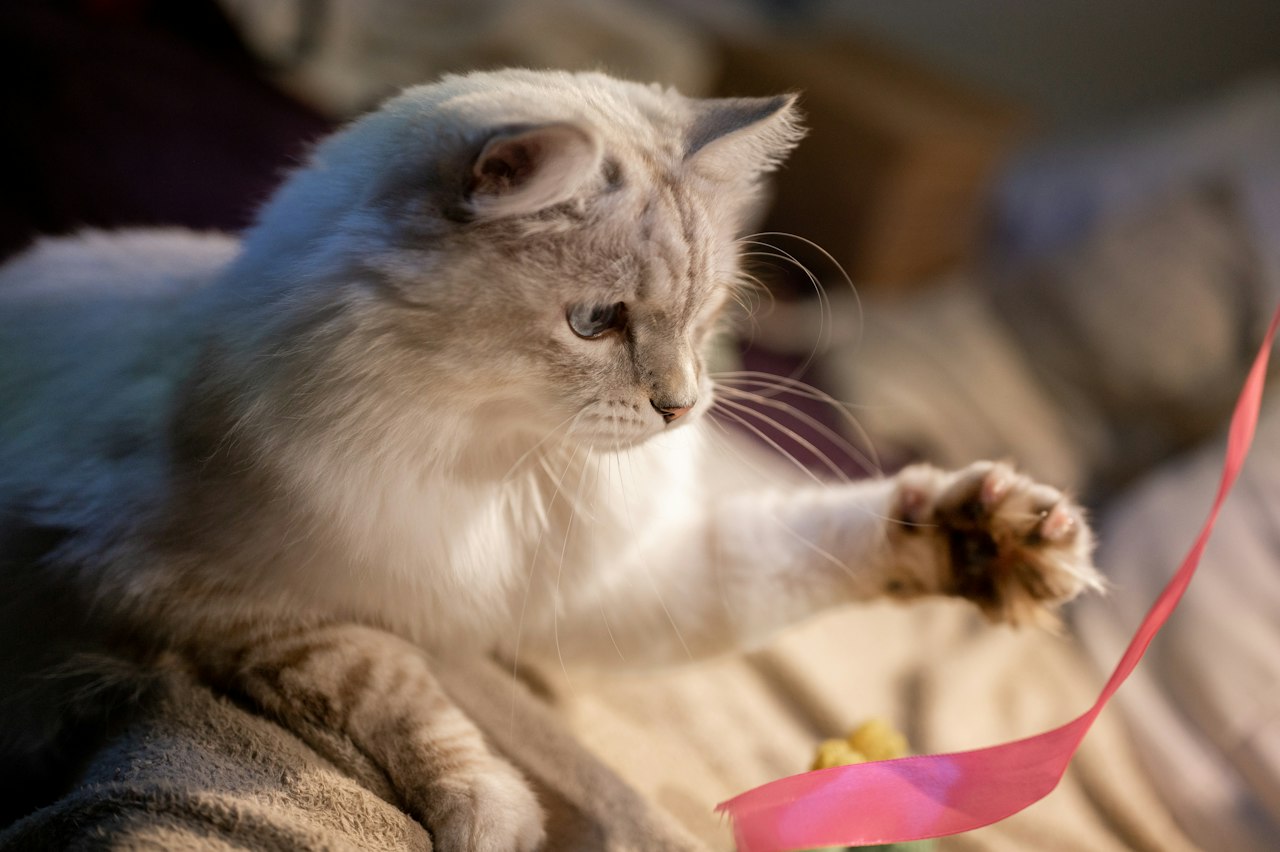
Imagine a quiet living room, a cat beside a sturdy chair and a wand toy making increasingly fast circles over the rug. The cat watches. I can feel the person’s temptation to try harder: faster movement, a brighter toy, perhaps another purchase. For this walkthrough, I would do the opposite. I would slow the toy and give that watching cat something clear to follow.
The part that interests me is the pause beside the chair leg, when the toy is briefly out of sight and the next move belongs to the cat. Battersea and Cats Protection recommend suitable play away from hands and feet, with opportunities to catch the object. I want to build the game around those choices—watching, approaching, catching and finishing—rather than around how energetically the person can move a wand.
Before moving the toy, I would clear the strip of rug beside the chair: the loose cable goes away, the glass comes off the low table, and the landing space stays on a stable surface. I look at where a turn would take the cat, not only at the attractive place to begin. A route that ends in a slippery patch or an unstable leap is not improved by a better toy. In this room, one modest clear path gives us more to work with than the original fast circles.
Keep other animals in mind. If two cats compete for the same moving object, one may spend the session watching from a distance rather than playing. Separate sessions can give each a clear opportunity. A dog interested in the wand may also change the cat’s willingness to approach. Arrange the setting so the intended participant can investigate without being crowded, and let another pet enjoy its own suitable activity elsewhere.
Begin with a modest movement at a comfortable distance. The cat may look, lower its body or follow with its eyes before moving. Do not immediately accelerate because a pounce has not occurred. Battersea describes toys that mimic prey movement and engage different parts of the hunting sequence. That gives the person a useful role: make the object interesting enough to investigate, then leave space for the cat’s response.
A toy dragged briefly behind a chair leg and allowed to pause may invite a different response from one repeatedly pushed toward the face. Keep the movement away from the cat rather than using the object to prod them into action. If the cat chooses not to engage, stop and consider the time, location or toy type. Play is an invitation. Repeatedly presenting the same difficult movement is not a reliable way to make it more appealing.
A game in which the object is always pulled away can become frustrating. Let the cat catch the suitable toy, hold it briefly or bat it within the limits of safe supervised play. Avoid immediately wrenching the object from the mouth or turning the catch into a tugging contest. The reward of the game can include successfully reaching what was being pursued. The person does not need to win every exchange.
This is one reason Battersea advises against laser-pointer play: the light cannot be physically caught. A tangible toy gives clearer opportunities for a successful conclusion. There is no need to claim that every game must follow an exact ritual to affect a particular hormone. The practical point is simpler: choose something the cat can interact with, vary the movement and let the sequence contain an achievable outcome.
Now I would sit where the wand keeps the active end well away from hands and feet. A small movement runs along that clear strip, pauses beside the chair leg and appears again. If the cat approaches, I leave room for a safe catch instead of lifting the toy out of reach at the last instant. Then I wait. The next movement depends on the cat remaining comfortable and interested; a look away or a pause does not oblige me to restart the action immediately.
The sequence can stay on the floor. There is no requirement for repeated high jumps, a long chase or a set number of catches. If the cat settles to watch, allow that pause rather than pulling the toy across their body to restart activity. A short comfortable session can end while interest remains. Put the wand away safely and leave an appropriate independent resting or play option available, depending on what suits the individual cat.
Afterward, note one useful detail: preferred movement along the floor, lost interest when the toy approached directly, or engaged when the room was quiet. Those observations give the next session a starting point. They are more informative than a verdict that the cat likes expensive toys or refuses exercise. The same toy can produce different experiences depending on how and where the person uses it.
If the cat ignores the toy, choose one variable to alter. Try a quieter time, a different movement or another suitable texture, rather than buying several objects and introducing them all at once. Some cats prefer activity close to the ground; others may respond to a different style. Keep the physical demands appropriate and ask the veterinary team about play if mobility or health affects what the cat can comfortably do.
Do not make hunger or frustration the tool for obtaining engagement. Food-related play should fit the feeding plan, and a cat should not have to complete a difficult puzzle to access necessary nutrition. Likewise, an animal who has stopped playing or moving normally may need a health assessment rather than a more dramatic toy. A sudden or persistent change in activity is useful information to discuss with the veterinarian, especially alongside other changes.
| What you notice | Try changing | Keep in mind |
|---|---|---|
| Watches but does not chase | Pause and use a modest floor-level movement | Observation can be part of play |
| Leaves when another pet arrives | Offer a separate quiet session | Access matters as much as the toy |
| Always loses the toy at the last moment | Allow a safe catch | The person does not need to win |
| New loss of interest or movement | Contact the veterinary team | Do not assume a shopping problem |
Hands moving under a blanket or fingers wiggled beside the cat may seem convenient, but they blur the boundary between people and toys. Cats Protection recommends games that direct hunting behavior away from the body. Use suitable objects and maintain enough distance that the active movement is clearly separate from hands, feet and clothing. Children need adult guidance and supervision rather than being asked to improvise a game with a highly excited cat.
If play begins to target a person, pause and make the next arrangement clearer. Do not punish or tease the cat with a hand just out of reach. Consider whether the toy is too short, the space too crowded or the session too intense. The practical correction is to change the setup and offer appropriate play, while seeking qualified help if the behavior is persistent, escalating or difficult to manage safely.
Wand toys, strings and detachable pieces need careful supervision and storage. Cats Protection and Blue Cross warn against leaving cats unattended with string-type toys because of entanglement or swallowing risks. After play, inspect the object and put it somewhere the cat cannot retrieve it. A high shelf is not necessarily secure storage for an animal that climbs. Follow the product instructions and discard damaged items appropriately.
A toy described as durable is not a guarantee for every cat’s way of using it. Watch whether pieces loosen, the material is chewed apart or the design creates an awkward trap. Do not improvise with fishing line, loose elastic or small household objects simply because the cat finds them interesting. If you suspect something has been swallowed or the cat is injured, contact the veterinary team promptly rather than waiting to see whether the next meal looks normal.
For the next session, I would keep the chair-side route and change only one useful detail, perhaps the timing or a suitable toy’s texture. If the cat watches longer before moving, I can leave a longer pause. If interest ends quickly, I can finish without buying a more elaborate object. What I want to carry forward is a specific observation about this setup, not a verdict that the cat is lazy or difficult. Variety becomes easier to choose when the first game has taught the person something.
For a multi-cat household, plan separate opportunities and notice whether the less assertive cat participates only when alone. Give each animal access to suitable play and resting choices. The most useful measure is whether the cat can engage comfortably and finish without being pursued into another round. A good game leaves the person with information for next time and the cat with a manageable experience, not simply a timer that has reached its target.
I would end this little living-room story with the wand safely put away, not with a final attempt to extract one more chase. The chair, clear rug and patient pause can give us a workable game to revisit. For me, that is the useful change: less effort spent making the cat perform, and more attention paid to the choices that make play worth joining.
A: It can be part of the sequence. Give the cat time to observe and choose a movement rather than continually increasing speed. Consider the whole response and the context. If interest or activity has changed suddenly or persistently, discuss that change with your veterinarian.
A: A tangible catch gives the game an achievable outcome. Battersea notes that cats may become frustrated when they never reach what they pursue. Let the cat interact with a suitable toy safely, rather than pulling it away every time or turning the game into a contest.
A: Battersea advises against it because the light cannot be caught. A suitable physical toy gives the cat opportunities to stalk, chase and catch. Choose a game that is safe for the individual cat and the room, with movement that does not require risky leaps.
A: No. Store string and wand toys securely after supervised use. Cats can become entangled or swallow loose parts. Inspect toys for damage and follow their instructions; an object that was safe while you actively managed it may not be suitable unattended.
A: Try separate sessions so each cat has a clear opportunity without competition. Observe whether the quieter cat engages more when alone. Keep other resources and space in mind as well, and seek advice if the household shows persistent tension or one cat is regularly blocked from activities.
Reference details checked Nov 10, 2026. Rules and guidance can change; follow the current source where applicable.
Something needs a correction? Let us know.
Compare routes, noise and everyday access to find the barriers a tidy-looking litter corner can hide.
Clear a route to food, water and the tray, reduce repeated visits, and know which changes need a veterinary call.
Use the marks on the sofa to choose a stable surface, a useful position and one change worth testing.