A litter tray location audit, from the cat’s height
Compare routes, noise and everyday access to find the barriers a tidy-looking litter corner can hide.
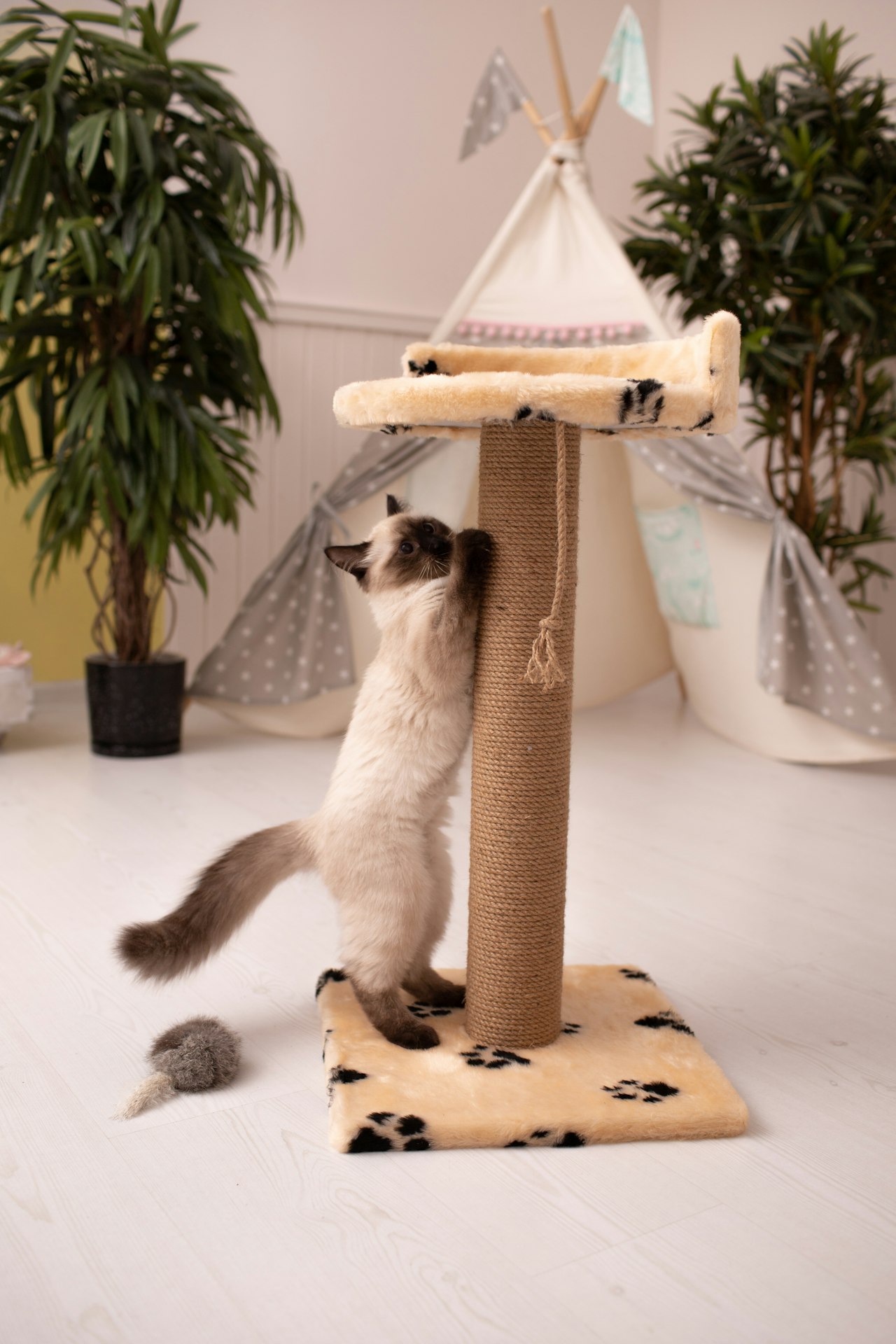
A scratching post can be perfectly new and perfectly irrelevant. Imagine a cat using the end of the sofa while a tall post stands behind a dining-room door. From a person’s perspective, an alternative has been provided. From the cat’s perspective, it is in another part of the home, far from the activity we want to redirect.
My starting point is the existing scratch mark. It tells us something observable: where the cat goes and whether the movement is vertical or horizontal. It does not tell us the cat is being spiteful. Scratching is normal feline behavior, and a useful setup makes an acceptable surface available where that behavior already fits.
A carpet patch and the side of a sofa suggest different movements. Note whether the cat stretches upward, reaches along a horizontal surface or uses more than one direction. Also notice when it happens: after waking, on entering a room or during ordinary movement around the home.
This is a small observation task, not a personality assessment. In that living room, the sofa end is on the route from a sleeping place to the doorway. That makes its position worth preserving when adding an alternative, even if another corner would look more symmetrical.
A surface that wobbles or slides may not offer the experience the cat is seeking. Cats Protection recommends appropriate scratching opportunities, including horizontal pads for cats who prefer that direction. A vertical option should allow a comfortable stretch and remain secure during use.
Before placing it, check the assembly and manufacturer instructions. Press gently yourself to find obvious instability without involving the cat in a test. A product’s dimensions on a webpage do not show how it will sit on your particular floor or how much space a cat has to approach.
Cornell’s feline behavior guidance recommends placing an appropriate scratching surface near the area already being used. That is a practical starting point: the new option competes with the existing one in the same context rather than waiting elsewhere to be discovered.
The scratcher beside the sofa may temporarily be more visible than the household would like. I consider that a reasonable trade-off while learning whether the cat uses it. Protect the furniture safely during the transition, but do not introduce something sticky, unstable or otherwise hazardous where the cat will walk or groom.
Use the living-room example to make the test specific. The cat scratches vertically at the sofa end after leaving a nearby resting place. Start with a securely assembled vertical surface close to that point, with enough approach space to use it. Leave the rest of the room reasonably familiar. The question is narrow: does an accessible alternative work in the place where scratching already happens?
If the new object wobbles, correct that before deciding the cat dislikes its material. If a door knocks into it, find a nearby secure position rather than expecting the cat to tolerate the disturbance. And if the cat consistently scratches a horizontal rug instead, that is a different movement to accommodate. A single product does not have to answer every scratching preference in the home.
Keep a brief record of actual use rather than watching continuously. Used the post after waking is useful; seemed ungrateful about the expensive tree is not. If the cat uses both the post and the sofa, the alternative may be partly successful rather than a total failure. Check its position and accessibility, protect the furniture safely, and ask for qualified help if the wider pattern suggests stress.
| Observed pattern | First feature to check | Avoid concluding |
|---|---|---|
| Vertical stretch at the sofa end | Stable vertical surface close to that spot | The cat needs the tallest product in the shop |
| Scratching flat carpet | A secure horizontal option | Every cat should prefer a standing post |
| Post shifts during use | Assembly, base and floor stability | The material has been rejected |
| One cat avoids a shared post | Access and separate locations | One shared tree is enough for all cats |
Do not take the cat’s paws and rub them on the post. Cats Protection warns against forcing this demonstration. Let the cat investigate and reward appropriate use with something they enjoy. The surface should become a useful part of the room rather than an object associated with being held.
A brief note is enough: which surface was used, where it stood and whether it moved. Avoid turning every approach into a noisy celebration or lifting the cat back after they leave. The aim is easy access to an acceptable behavior, not repeated handling around a new object.
Rewarding use also needs to fit the individual cat. A quiet acknowledgement or suitable reward should not interrupt the behavior so enthusiastically that the cat leaves. Keep hands away from the scratching paws and allow an easy exit. The useful outcome is a surface the cat returns to independently, including when nobody is standing beside it with encouragement.
A scratcher that works during the first week can become less useful when the room changes. A laundry basket blocks the approach, a door begins hitting the base or the surface is moved to make room for guests. Check those ordinary changes before deciding the cat has lost interest. The cat may still prefer the same direction and material while finding the location harder to use. Keeping the approach clear is a maintenance task just as much as replacing a worn surface.
Inspect the object according to its instructions. A loose fitting, damaged surface or unstable base needs attention before more use. Do not cover a problem with another layer of material that introduces loose threads or an uncertain attachment. If the product has reached the end of its usable life, choose a suitable replacement and keep the successful location in mind. Familiarity is helpful, but it is not a reason to retain something that has become unsafe.
When replacing a favorite scratcher, avoid making every feature new at the same time. A similar direction and position can preserve useful parts of the arrangement while the cat explores the replacement. There is no guarantee that a visually similar product will feel the same under the paws, so watch actual use. The goal is to continue offering an acceptable outlet, not to make the cat validate a particular purchase because the household liked the old one.
With more than one cat, a single prominent post can become a shared resource that is not equally easy for everyone to reach. Map where each cat rests and moves, including locations where one tends to wait for another to leave. You do not need to label one cat a bully to notice that a narrow passage is difficult. A second suitable scratching place on another route can create a choice without forcing the cats to use the same object together.
The placement should serve the individual movements you have observed. One cat may scratch vertically beside a resting place while another uses a horizontal surface near a different room. Buying two identical towers and placing them beside each other may increase the number of products without providing a meaningful alternative destination. Think in terms of access and context. Keep other resources, such as resting places and feeding areas, in the broader picture when the cats appear to be competing for space.
If scratching increases suddenly or appears alongside hiding, conflict, appetite changes or other concerns, ask for veterinary advice. Rearranging surfaces can be useful, but it should not replace assessment of pain or a wider behavior problem. Describe where the change occurs and what else has changed in the home. A qualified behavior professional may help after health questions have been addressed. Keep the practical experiments gentle and reversible while that support is being arranged.
If a stable vertical post is ignored while a nearby flat pad is used, that is useful information. Keep the successful option and reconsider the unsuccessful one. A different material, orientation or location may be worth trying, but changing all three together makes the result less informative.
Sudden changes in behavior, signs of pain or a wider pattern of stress deserve veterinary advice. If scratching remains difficult to manage, ask about qualified behavior support. Household arrangements should also provide enough resources and space for multiple cats rather than assuming a single tall tower answers every need.
Once a position is working, resist a complete furniture reset. Moving the scratcher behind the same dining-room door that failed before simply recreates the original problem. If the household needs a less intrusive arrangement, make small practical adjustments while preserving a useful option near the established spot. Take use, not the room’s symmetry, as the deciding evidence.
Study the place where scratching already happens before buying a larger tree. A stable, appropriately oriented surface near that spot creates an experiment you can learn from. Let use guide the arrangement, keep any successful option genuinely accessible, and remember that a scratcher earns its place by serving the cat’s routine—not by disappearing neatly into the background.
A: Not necessarily. Scratching is a normal behavior with several functions. Consider location and context instead of interpreting damage as deliberate retaliation.
A: A stable surface that permits a comfortable stretch matters more than an extreme height. Horizontal options may suit some cats better.
A: An abrupt move may remove the location that made it useful. Keep a successful position while considering gradual, practical adjustments, and watch whether the cat continues to use it. If the new location is ignored, restore a useful option rather than insisting the cat cross the room to match the furniture plan. Protect the original area safely during the transition.
A: No. Forced demonstrations can be unpleasant and create avoidance. Allow voluntary investigation and use.
A: Multiple suitable locations can reduce competition and provide choice. Consider each cat’s routes and preferences rather than buying only one shared object.
Reference details checked Nov 10, 2026. Rules and guidance can change; follow the current source where applicable.
Something needs a correction? Let us know.
Compare routes, noise and everyday access to find the barriers a tidy-looking litter corner can hide.
Clear a route to food, water and the tray, reduce repeated visits, and know which changes need a veterinary call.
Prepare separate living spaces, use small introductions and let ordinary comfort decide the next step.