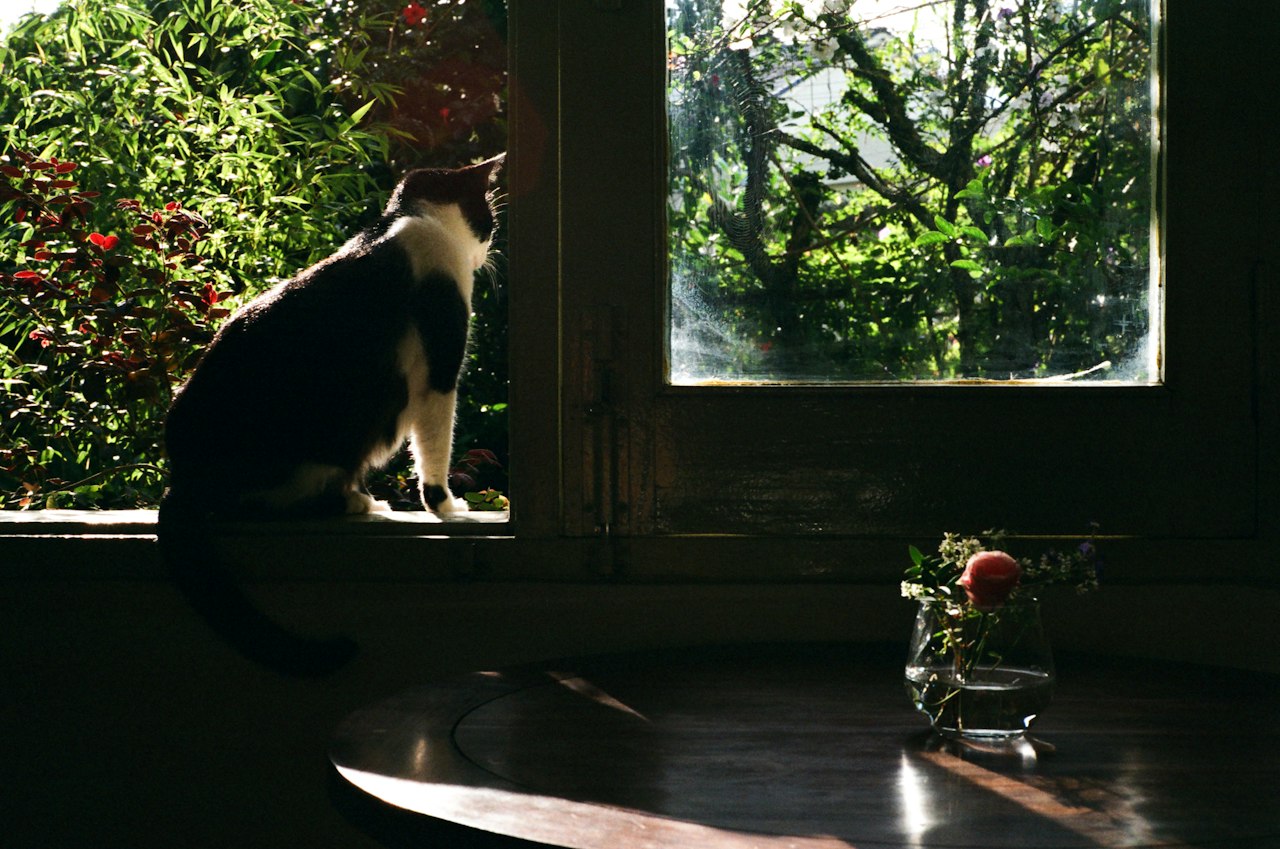
Before the bouquet goes on the table
A practical arrival routine for flowers in a cat household: identify the stems, handle uncertainty, and make the next delivery easier.
A cat flap looks simple from standing height: an opening, a moving panel and perhaps a lock. From the cat's position, I would also want to notice the route toward it, what is visible beyond it and whether another animal can block the return. Before treating hesitation as a training problem, I would ask what the household is actually asking the cat to approach. The object in the door is only part of that question.
Imagine a fictional cat, Nell, and her person, Tess. Their existing flap connects the home with a suitably secure cat enclosure, and Tess can supervise both sides. This is an illustrative planning example, not an account of a cat I trained or a guarantee that a particular enclosure is safe. The exercise assumes the access arrangement is appropriate for the individual cat and local circumstances. It is not a recommendation to introduce unrestricted outdoor access or to cut a new opening into a door.
Before Tess opens the flap for practice, I would have her look from Nell's height at both approaches. Is a laundry basket narrowing the indoor route? Is there somewhere for the cat to pause without being cornered? Does the destination provide a safe, manageable space rather than an unexpected exposure? I would settle those questions before thinking about treats, a timetable or a photograph of a successful first crossing.
The RSPCA's home-environment guidance emphasizes security, hiding places and opportunities for cats to get away from one another. I use those principles to look beyond the door panel. In this invented home, another pet waiting immediately beside the opening could change the practical experience even if the flap itself is suitable and functioning. A training plan should not ask Nell to solve a route that the people could make less awkward.
I would also identify the fallback before starting. If the lesson ends with Nell on the enclosure side, Tess must still be able to provide a safe return. If the arrangement cannot support that, I would change the setup rather than begin and hope the cat quickly learns the mechanism. A new doorway skill should not become the only available way to reach familiar shelter during a practice session.
I would read the instructions for the actual flap before changing its settings. Fit, installation, locking modes, power requirements and the way an electronic model recognizes a cat are equipment questions. A generic article cannot confirm those details for a particular product or door. If Tess is uncertain about a glass panel, a fitted unit or a lock, I would have her consult the maker or an appropriate installer rather than improvise a structural alteration.
Cats Protection describes both ordinary and selective-entry flaps, including microchip-operated designs that can limit entry by unfamiliar cats. I would treat that feature as something to configure and check according to its instructions, not as proof that every access problem has been solved. A familiar cat still has to approach the opening, use it comfortably and reach a suitable space on the other side.
In Nell's example, Tess would check the intended practice mode while the cat is elsewhere, then confirm it is the mode she meant to select. I would record the setting in plain language rather than rely on a symbol somebody else might misunderstand. That little household note is especially useful when two people use the same door. A well-intended setting change by the second person should not unexpectedly remove the return route planned by the first.
For the first invitation, I would make the passage open in the way the maker permits and let Nell choose how close to come. Cats Protection's training advice begins with an open flap, encouragement and small rewards, then practice in both directions. I would not turn that guidance into a requirement to complete a crossing on the first attempt. An approach that ends with the cat calmly moving away can still tell Tess something useful about the setup.
Suppose Nell walks toward the doorway but stops several feet short. I would have Tess notice where that happens rather than repeatedly move a reward farther away. Perhaps the practice location is too busy, perhaps the opening is still unfamiliar, or perhaps the session simply needs to end. Those are possibilities to consider, not diagnoses from a distance. Tess does not need to decide that Nell is stubborn in order to make the next invitation easier to understand.
I would avoid pushing a cat through, restraining the body at the opening or trapping the animal on one side to force a decision. My preferred measure is voluntary investigation with room to withdraw. That keeps the session aligned with the purpose of the route: a useful option for the cat. The household should not have to create an unpleasant experience to obtain the appearance of quick progress.
Once Nell chooses to pass through an open flap, I would not immediately call the job finished. Tess needs to observe the approach from the other direction too. The spaces differ, the view differs and the person offering encouragement may be in a different position. I would want the cat to have time to investigate that return without another pet, a moving chair or an excited audience gathering around the doorway.
The two-way practice in Cats Protection's guidance is the important sourced point here. My added household question is how Tess will preserve it when normal life resumes. If a storage box is returned to the indoor approach after every session, the practice setup and everyday setup are not the same. I would make a clear place for that box elsewhere before expecting the new route to become dependable.
In this example, a useful note might say Nell investigated the open passage toward the enclosure and returned with Tess nearby; the panel and electronic operation have not yet been introduced. That is more informative than cat flap learned. It distinguishes an observed step from the additional parts of the task. It also prevents the next household member from assuming that an early crossing justifies changing the lock or leaving the cat to manage alone.
I would introduce the flap's movement only after the open passage has become comfortable, using the product's instructions and allowing the cat to progress gradually. I would not specify a number of sessions that every cat must complete. The practical question is what Nell is choosing to do now, rather than whether she is matching somebody else's short video of a very different cat and door.
Tess can keep the observations small: approached the opening, touched the panel, moved away, returned later. I would record those actions without converting them into a story about courage or defiance. If a new stage makes the arrangement less workable, the next decision may be to simplify the session, review the equipment or seek suitable help. Repeating the same invitation with increasing pressure does not resolve an unclear setup.
The electronic sound or locking behavior of a particular flap belongs in this gradual introduction as applicable, but I would not invent instructions for bypassing its mechanism. Follow the maker's supported operation. If the flap seems to obstruct, catch or otherwise be unsuitable for the cat, stop using that arrangement and investigate. The aim is a comfortable route, not an impressive training result that requires overlooking how the equipment behaves.
A flap can have a straightforward mechanical operation and still sit in a socially difficult location. If another cat regularly occupies the only approach, I would look at the household arrangement rather than focus exclusively on the panel. The RSPCA advises providing enough space and resources for cats to get away from each other. A selective-entry feature does not by itself arrange the relationships between cats that are already authorized to use it.
For Nell and Tess, I would choose a quiet practice time and keep other animals from crowding the doorway without creating another stressful confrontation. The details depend on the home and the animals. A new session should not rely on one cat being held nearby while the other is coaxed toward them. Where tension persists, qualified behavioral support may be more useful than buying another gadget and hoping it changes the entire situation.
I would also watch the ordinary route outside practice. Can Nell choose another resting place or retreat without going through the flap? Does the enclosure remain appropriately secure? The training task does not replace those environmental checks. I want Tess to see the passage as one option in a workable home, rather than the solution to every disagreement, hiding episode or access problem involving a cat.
If a cat who previously used a flap comfortably starts avoiding it, I would not assume that yesterday's training plan is the right response. Check the equipment, settings, approach and any changes around the route. Concerns about pain, difficulty moving, sudden behavioral change or other signs of illness belong with a veterinarian. This article cannot assess a cat's health or establish that reluctance is purely environmental.
The final household note would identify the current operating mode, the maintenance instructions, who checks it and the safe alternative if it stops being usable. In Tess's example, that leaves a clear handover rather than a triumphant but vague claim that Nell now knows the door. A useful route has to keep working after the first success, and the people responsible for it need to know what to do when its conditions change.
I would call Nell's route useful when she can choose it comfortably and Tess understands how to keep it usable. That begins before the moving panel: with a suitable destination, a clear approach, a way back and no pressure to perform. The cat's choices, rather than the first photograph of a crossing, tell me which question comes next.
A: I would not force a crossing. Begin with a safe, supervised setup and an open passage as the product permits, invite voluntary investigation and allow retreat. If the cat is uncomfortable, stop and reassess the equipment and environment rather than increasing pressure.
A: Selective entry can help limit access by unfamiliar cats, but the actual functions vary by product. It does not automatically resolve crowding, conflict between resident cats, suitability of the destination or a cat's comfort with the mechanism.
A: There is no timetable promised here. The relevant observations are whether the individual cat approaches, passes through and returns comfortably as each supported stage is introduced. A quiet voluntary step is more useful than finishing by an arbitrary deadline.
A: No. The hypothetical example uses a suitably secure enclosure with supervision and a dependable return. Decisions about access must fit the cat, local conditions and any relevant requirements. Practicing a mechanism does not establish that the destination or outdoor arrangement is suitable.
A: Review changes to the equipment, settings and route, and keep a safe alternative available. Seek veterinary advice for concerns about pain, mobility, sudden behavioral change or illness. Do not assume every new hesitation calls for more training.
Reference details checked Nov 27, 2026. Rules and guidance can change; follow the current source where applicable.
Something needs a correction? Let us know.
A practical arrival routine for flowers in a cat household: identify the stems, handle uncertainty, and make the next delivery easier.
Compare routes, noise and everyday access to find the barriers a tidy-looking litter corner can hide.
Check the window, the support and the return route before turning a sunny ledge into a cat’s favorite seat.